

Niia is Figuring Out what Jazz Means to Her
The LA-based songwriter chats about “Moonstruck” and being an introverted performer

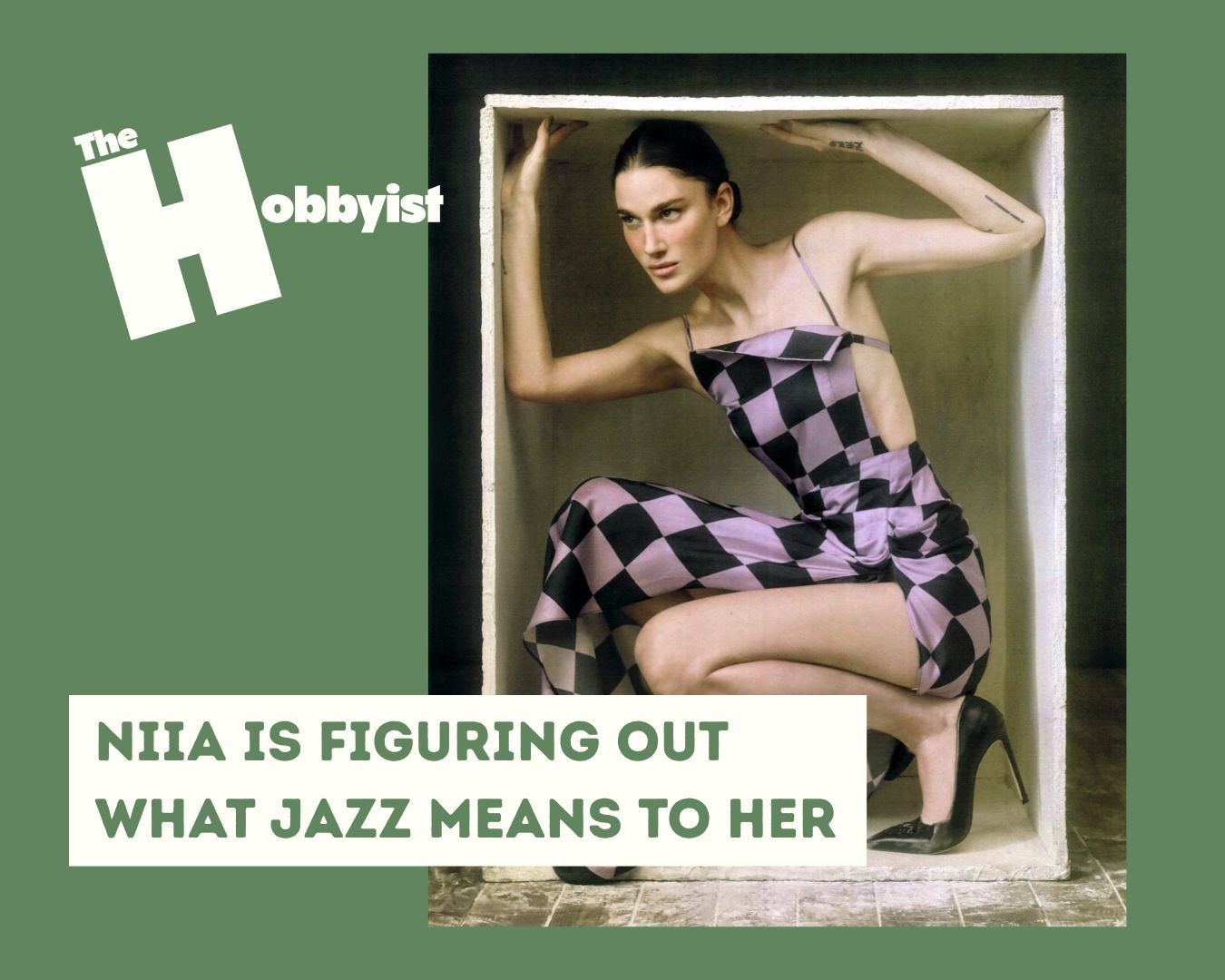
Photo by Szilveszter Mako; graphic design by Thomas Euyang
I first discovered Niia’s music thanks to a little known provision in the official Hobbyist handbook. It hath been declared that I have a duty and obligation to shareholders to listen to any release that involves the work of one Spencer Zahn. When I was pitched on Niia’s brilliant new LP, V, I was lawfully required to listen as it was produced by Mr. Zahn. While the songwriter and producer adds some sauce behind the scenes, it quickly became clear that I shoulda been giving Niia tons of my time regardless of who she had behind the boards. V is a romp; a jazz-funk, pop-soul, electro-R&B opus built around themes of isolation, confidence, and desire.
On V, Niia wanted to present all the different sides of her artistry, from her jazz training background to the artists she became enamored by as a young adult: Flying Lotus, BADBADNOTGOOD, Thundercat. Like so many in that latter realm, Niia has taken her jazz chops and fused them with her prowess as a pop songwriter and willingness to experiment. It’s resulted in a jazz fusion a far cry from the world of Weather Report or Mahavishnu.
Namely, because this jazz band has a singer; a brilliant one at that. Niia’s expertise as a jazz singer allowed her to approach V as another player in the band. She stands front and center, singing a story on a song like “f*****g happy,” but a song later, on the Moonstruck-inspired “Ronny Cammareri,” she eschews words to reframe her voice as just another instrument in the fold. It’s a thrilling approach, and became a really fascinating part of our chat. We also talk about cooking, trying to take care of plants, and the horror of reciting words in front of other people. A few things you can do below: check out our conversation, edited for length and clarity, and buy Niia’s V.
Press materials that accompanied the album promo mentioned that this album was a way for you to figure out what, exactly, jazz means to you. Was that clear to you once the record was finished?
Niia: I know what I think jazz is, at least right now. Jazz is so many things. That’s what I think the real irony is. It’s been defined in such a way that I’m disappointed. There hasn’t been any other opening, a different way to say what it is. There seems to be limits on how we can describe it, which sucks, because jazz is pretty hardcore, jazz is pretty punk.
Yeah, you establish pretty early on that if what you’re doing is “jazz,” it can be so many different things.
N: I’m trying so many things.
You grew up studying jazz, too. What’s it like doing something professionally that you dedicated so much of your childhood to as well?
N: I think about this now that I’m talking more about jazz and my old background. I come from a family of a lot of musicians and we all were very much about the craft versus the showmanship and the hype. Even back when I was at the conservatory, I really had no idea what I was going to do, I didn’t have an idea that I could do this as a career. I didn’t ever want to be famous. It was always just about technique, being the best at your craft. It’s funny that I used to sing in big band jazz ensembles in Louisville or some place. I went to band camp, I was competing, and now I get to do this as my job and career. That connection was very strange, because I never imagined jazz would lead me to a career or being able to do my passion as my job.
That’s what happens with jazz kids. You’re in this bubble where you just want to learn everything and then one day it pops and you’re like, ‘Oh, I have to be a dentist now, or I have to get a real job, or just play in the back of restaurants,’ which is such a shame because we’re not taught that this can be done as a living. We just want to be so good at our craft and we love it. That’s been the most interesting thing for me to realize, I’m doing what I love, and it’s also what I’ve studied for most of my life.
I first discovered your music because I’m a big fan of Spencer Zahn. Who else is in your musical community?
N: I am a real isolator and a real introvert at heart. The irony is that I love collaborating. I grew up being thrown in all these different ensembles and being the hated vocalist, I learned how to get along with people. One of the most crucial things I learned is the importance of listening to others. In jazz, silence and pulling from other people is where you really grow. I really wanted to tap into some of the best players I know, or just ones that were doing things that I could have never thought of; people that have their own voice. It was challenging because everybody is so talented and has their own thing. I’m not really a dictator when it comes to that stuff. I’m more, ‘Let’s just fucking see what happens.’
Luckily, it just started to come together naturally, and it was a really amazing experience. I was awkward and shy most of the time, but it started to reveal itself. I tended to put us all together and then take the recordings and hoard it, do my own thing a little bit so no one can watch me fuck up. Then I come back and share it with everyone, especially with lyrics and top lines and melodies. All in all, it was really amazing, and I’m so lucky I got to work with some of the best players around.
I feel like singing words in front of other people is a uniquely unsettling feeling.
N: It is horrifying. I tend to do better when I’m alone. We would jam and I would get some rough melodies, but then me and the songwriter I trust most would work on the lyrics together. I could never just stand in a room and be like, ‘Hey, this is what this song’s about.’
When you got into the studio, was most of the album sketched already?
N: Some of it was. Like, “f*****g happy,” I had a little shitty piano demo for. Then, with the band we expanded it. For others, we had some drums or some little directions we wanted to go. We made a lot of music for the project. Some was good but didn’t make it because it had too much of a Motown feel, or didn’t fit in with the rest of the songs. We started to see the nucleus of what was happening and that helped us realize how to expand on those ideas.
“f*****g happy,” I love that song. Talk to me about the idea that feeling good doesn’t last. Sort of like, we can’t have nice things.
N: It’s something that I struggle with every day. It’s the rage and the peace within moving on and letting go. I’m a water sign, so we tend to hold really big grudges, and I’m such a sensitive fucking psycho that it’s hard for me to let go. But also, I’ve written so many breakup song that I really wanted to try to find another way to convince myself of, ‘I can do this, but also, don’t fucking try, or it might all fall apart.’ Sonically, I wanted that one to be a bit more theatrical. I wanted it to have a lot of different chord progressions and dynamics in it. That’s awesome. It’s incredible.
Talk to me about “Ronnie Cammareri.” A great character in a great movie. Maybe my wife’s favorite movie of all time.
N: It’s one of my favorite movies. I was just watching it one night and I was like, ‘Damn, Ronnie is just such an icon.’ He’s so bittersweet and naïve, but also brave. I wanted the song to not have lyrics so that the vocalist wasn’t the main event. I was always the hated vocalist in every ensemble. The players were like, we want to fucking play. We don’t want to swing behind a singer. I really wanted to have it have an essence and a personality and the music does that. Calling it “Ronnie” just made sense. I love Nic Cage. I love his character in Moonstruck. He’s just so raw and vulnerable and puts himself out there. I’m trying to be more like Ronnie.
Even when he’s not speaking, he wears his face so well. It goes with the idea of not having lyrics in that song. You get the emotion of it without having words.
N: It’s funny though, because a lot of these Gen-Z fans of mine are like, ‘Who the fuck? What is Moonstruck? I’m like, ‘Oh my God, I’m so old.’ I’m hoping more people will understand. I’m thinking about making a t-shirt with his wooden hand on it.
Do you have a favorite place to perform when you’re touring?
N: I’m so introverted and I really didn’t like touring. I had a lot of stage fright growing up in my jazz bands. It was less about entertaining and I could turn my back to the audience. Nobody really cared about my show. I’ve learned through trial and error that the connection I make with the fans is so powerful and special that I can’t disrespect my audience and turn around. I started to really embrace performing. All the places I’ve been have just been so different, which is what’s so cool. Asia was probably one of the most eye-opening places. I was in China last year, and people had specific lyrics that spoke to them. It was really powerful.
What’s something that you wanted to do with this record that was new? Something you’ve never tried before?
N: I wanted to ground myself. My last record was really fun. I got to work with Jonathan Wilson, who’s an icon. I don’t really sound very good with acoustic guitar. It was trying some folk and rock stuff that I really love, but it wasn’t fully settling in the right way. I needed to find my way back to sonics that felt forever Niia in a way, but still not settle for making a traditional jazz record or a throwback record. That’s s in my future as I get older, that will be the hill I want to die on; singing Chet Baker standards. I’m not ready to do that just yet.
I wanted to figure out how a vocalist that is jazz trained, but has some other styles, too, can exist in the jazz space now. That’s where bringing in all these incredible musicians helped; ambient, experimental, singer-songwriter stuff was really influential to find that sonic grounding. To the point of Ronnie, I think sometimes when I hear modern day jazz singers, it’s all about their voice in every song. They’re always in the forefront, and that’s amazing. But it was important to experiment. It was about playing with space and letting the record breathe in a way that felt like it represents me without having to sing or spell out everything all the time.
How do I exist when there’s Thundercat, BADBADNOTGOOD, Flying Lotus, all these really cool bands, but then on the other hand, there’s all these amazing vocalists too. Bridging the gap between experimental, modern jazz and traditional vocal jazz was a huge gap. I wanted to see if it was possible to find a little bit of a bridge to bring in some of that more experimental cool shit into something that also can be very traditional and straight ahead.
In LA there’s been a huge mingling of the worlds of jazz and electronic music, but not really vocal-heavy jazz.
N: It’s hard because jazz is such a purist’s world. Because I’ve done R&B and I can use my voice in lots of different ways, I’m not a “jazz singer.” That’s where I’m trying to redefine what a jazz vocalist can sound like. I can swing some stuff, and I’ll find a time to do some swinging standards, but until then, I have all these amazing players at my disposal to create something new. That was really the goal with this, and it was challenging. It was hard.
How long did it take you to actually record the album?
N: Probably a year and a half or two years. We started it and then after maybe the first year, it was close, but it was missing some baking soda or something. That’s when we brought in Spencer and we did a song, and we were like, there’s something here. Maybe we should do a little bit more. Then we just compiled the ones that all fit together, and the album began to form.
Is there something you hope a listener of this album takes away from it after giving it a listen?
N: I hate telling people how to feel when they listen to my music, but I feel that it’s a pretty heavy record. The lyrics are pretty dark. They’re also pretty sarcastic, so it feels a little chaotic. Sinister is a heavy word, but it’s a little melancholy and sinister. There’s a bit of aggressiveness and this existential tone to it in some regard. To me, jazz is always in that world. It’s the sarcastic heartbreak, the melancholy feelings. I just wanted to be raw and vulnerable and present where I’m at.
I hope that it’s helpful for people because we live in such a crazy time. Everything on my Instagram feed is self-help therapy. It almost kind of fucks with your head. It’s like, I have problems, everything’s wrong, nothing’s going to get better if I don’t download this self-help app. I wanted the album to be provocative because I think it has to cut through in some ways, but I wanted it to be true to me. I hope it helps people own their shit and realize it’s okay to be fucking miserable. It’s okay to want to have sex as an escape. It’s okay to be sad and miss somebody. It’s not linear. Hopefully it makes listeners feel less alone. That’s what I really hope.
There are great videos for these songs and I love the album art and vinyl formatting. Have you always been interested in the multimedia aspects of music?
N: I think so. I mean, I grew up watching a bunch of inappropriate Italian films. My mom’s from Italy, so I grew up watching a lot of gangster movies and a lot of amazing Italian cinema. From there, I branched out to a lot more foreign films. I’m such a visual learner, and it really helps me imagine stuff. I’m super sensitive, and when I moved to LA, it was terrible for my writing. I couldn’t write with a pomegranate tree outside. I had to take on this tortured artist thing. It’s been a bit of a challenge to release myself from having to be this dark character to create stuff.
When I used to drink, I would drink before trying to write fiction, because that’s what artists do. And then you end up just not doing anything because you get fucked up.
N: Totally, I just did a workshop in Arizona about empowerment and confidence, and there was some shame attached to my process. Like, you have to be one way in order to create. Both can exist. I can write affirmations and still write a really fucked up song. I don’t have to carry it through my life. I can let it go.
What do you like doing when you’re not writing music?
N: Lately I’ve picked up gardening, however, all the flowers I planted are dead. I’m not sure how good I am at it.
What sort of peace does that bring you? Before the plants die, of course.
N: My intrusive thoughts are gone when I have to do something. Another thing I really love is cooking. I’m a huge chef. It’s the same thing where I have to focus. It’s really meditative for me to buy the groceries. The ritual, that’s a big one for me. I also just love driving around LA. I can just drive for hours going nowhere.
Cooking wise, are you a recipe follower or are you purely instinctual?
N: I cannot bake to save my life. I cannot follow instructions. I’m like the Italian a little bit of this, a little bit of that. I’m a good cook, but I’m a terrible baker. Something always goes wrong. It’s all feel for me, and I can really only do Italian. I can make a good salmon bowl, but I can’t do anything else. I get a little lost in the sauce.
Was your mom or dad a big cook?
N: My mom was a great cook. Food solved everything in our house. We were forced to eat everything, and Sunday dinner was our big night. Everyone had to be there.