

Naeem Juwan Reads Four Books at Once and Doesn’t Take the Scenic Route
An interview with the artist formerly known as Spank Rock about “Bankroll Peelers,” merging his personas, Justin Vernon, and techno.

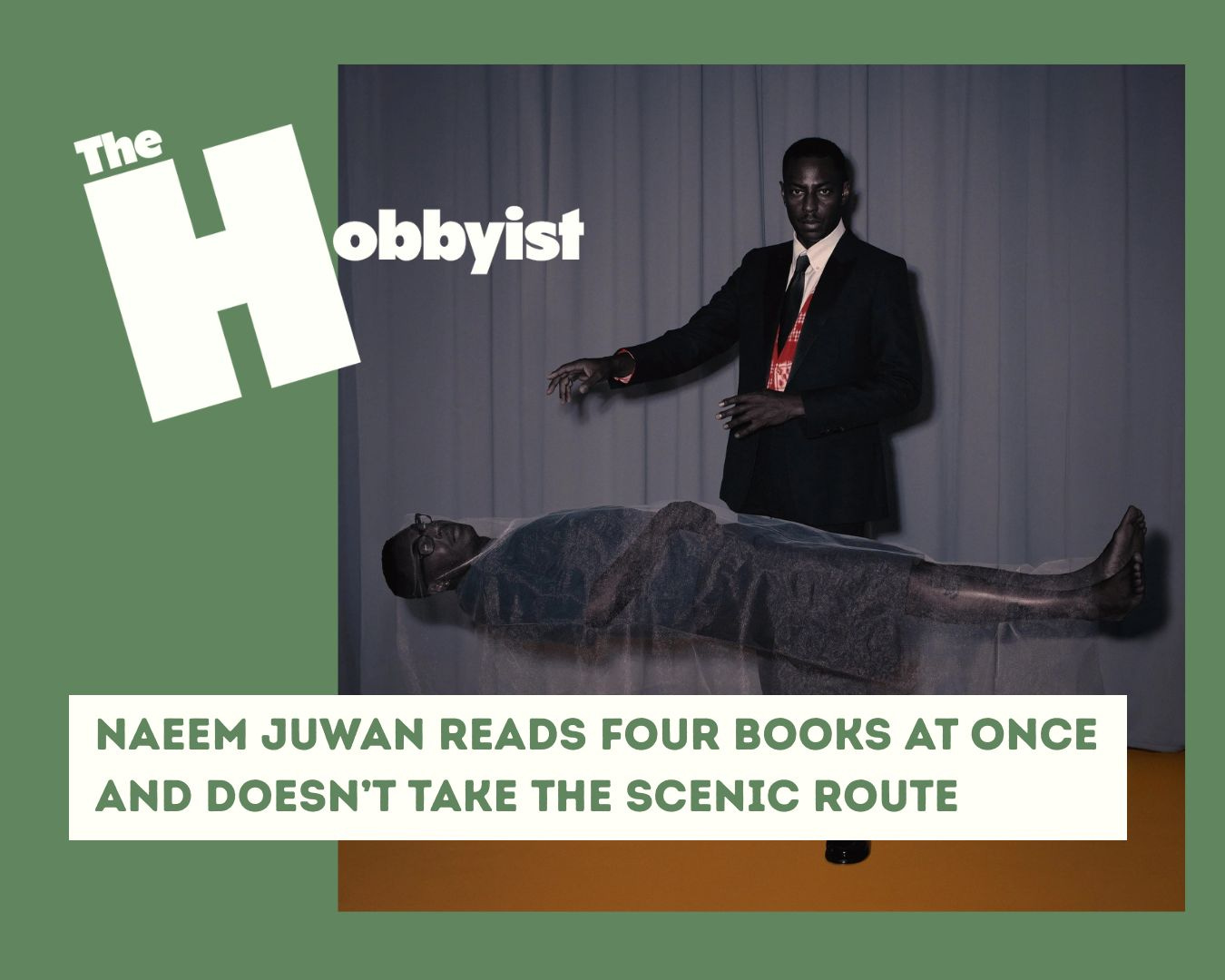
Photo by Scott Ross; graphic design by Thomas Euyang
It’s Sunday, the first night of Hanukkah, and snowing in NYC so I figured it’s a pretty good time to run one of my favorite Hobbyist interviews to date. The idea to interview Naeem Juwan AKA Naeem FKA Spank Rock was spurred by the release of his 2025 single, “Bankroll Peelers.” That song is a Spank Rock and Naeem collaboration, the fusion of two distinct personalities he has spent years trying to identify in separate, unique ways. Alas, the force is too strong to keep ‘em apart forever. Long before “Bankroll” arrived, though, the Baltimore-born rapper and songwriter was an instrumental part of my desire to be a music journalist.
Allow me to take you back to 2009 or so. I was 15 or 16 and secured a press pass for the traveling Rock The Bells rap festival. In hindsight it was actually a pretty legendary lineup. A Tribe Called Quest, Mos Def + Nas, Method Man + Redman, Raekwon + Ghostface Killah, The Pharcyde and more were all performing. As a boisterous rap obsessed teenager, I was equally excited for the indie acts scheduled to perform: The Cool Kids, Jay Electronica, Wale, Amanda Blank, and her frequent partner in crime, Spank Rock. I had somehow stumbled upon unauthorized backstage access, and while most acts avoided a 15-year-old kid with skinny jeans and a Lupe Fiasco t-shirt, Spank Rock and Amanda Blank hung out with me for like 45 minutes. It was incredible, a true act of kindness, and made me want to be around musicians as much as I could.
Fast forward to 2025. I get to do that, which is awesome, and I remain immensely grateful that I’m in a position to speak with artists like Juwan. Almost 20 years later and I get to thank him for a moment that meant nothing to him but everything to me. That’s pretty cool!
More importantly, we discussed the differences between his Spank Rock and Naeem personas, living in LA and writing screenplays, and all the amazing shit you can learn from books. I hope you enjoy this conversation, both for the full circle moment it represents for me and as a fascinating look at one of indie music’s most thoughtful pioneers.
“Bankroll Peelers“ features two different musical personas…Spank Rock and Naeem. How did you go about merging them?
Naeem Juwan: Damn, I don’t know how to answer this. I guess when I first started Spank Rock, it was just this whirlwind of a time. The name wasn’t even something that I really meant to hold on to and have as a brand. It just stuck with me over some weird college party. It had quickly become something that I wasn’t in front of. I knew what my morals were, I knew what rap was missing at the time, I knew what my influences were. Alex Epton [XXXChange], who produced the first Spank Rock album, was blowing my mind with all the new music he was feeding me. There was punk and post-punk I didn’t know about, and that was just really fueling my spirit. It became this fireball of expression and it started becoming popular pretty rapidly. I found myself in a place that I don’t think I was really prepared to be.
It meant a lot to people. It meant a lot to the people who were in the audience, and it was extremely underground. There was no TikTok, there was no Instagram. These things were happening in the New York underground, the San Francisco underground, the Baltimore underground. We were in the worst clubs, the worst warehouses. It was fueling my own success as a musician, but it was really cracking open a lot of new thoughts. People were experiencing a lot of freedom that they hadn’t experienced before by coming to those early shows and listening to the early music. But you couldn’t really hold onto it. It came and then it was gone. Then, as I continue to make music and put albums out, the industry keeps changing. Every year some new technology changes in the music industry, the amount of money that you can make from being a musician just changes; everyone’s chasing to keep up in the industry. Naeem came out of the shedding of this very ephemeral, Spank Rock experience that I couldn’t quite control.
It got really popular, and then all of a sudden people are rapping some of the most vulgar shit you’ve ever come up with back at you on stage and you’re probably like, ‘What is this?’
NJ: The funny thing is, it was vulgar back then during that time, but compared to what we’re used to hearing now, it doesn’t seem vulgar at all. Explain that to Sexyy Red. They’ll listen to it and be like, ‘whatever.’
Like, ‘is this censored?’
NJ: I had to shed that past to be able to write music that I thought was truly important to me. That’s where I was when I put out music under my own name, Naeem, and made the Startisha album. That album was way more personal and drew from real experiences, looking back to my childhood.
So, you have these two things. One is Naeem, more of a traditional singer-songwriter. Spank Rock is more of a trickster character that’s really trying to fuck shit up, to take a piss at backpack rap and the underground hip hop scene I had grown out of, but also grew tired of. Those are the two different things that I’m trying to bring together: Someone that’s introspective, but then someone who’s also here to fuck shit up.
That’s what makes “Bankroll Peelers” such a perfect song. It’s equally weighted with both of those spirits in it.
NJ: I’m happy to hear that you can feel that.
Where did the Justin Vernon connection come from?
NJ: That was really random. One of my amazing friends, Ryan Olson, is a producer in Minneapolis. He produces this amazing band Poliça. Ryan hit me up one day and invited me to come be a part of a festival that Justin Vernon was throwing, the Eau Claire Festival. Around that same time, they were also doing this really experimental music camp festival week in Berlin at the Michelberger Hotel. I got invited to that as well through Ryan. He’s awesome. He’s this hilarious, tall dude that has that really old school punk mentality. He’s just talking shit all the time, smoking cigs. But he brought me into this world of all these incredible singer songwriters, musicians that I would’ve never really been a part of. Justin and Aaron Dessner were leading the festival, and it was a lot of collaboration.
I had written Startisha in Philly, but I needed to do extra production on it. I went to Minneapolis to work with Olson, who helped me fine tune all the demos. During that time, Justin was also sharing his space with a lot of musicians. We were always out in Eau Claire at April Base, his studio out there. I just worked on finishing my album out there. He happened to be around a lot, and he would listen to what we were doing. Sometimes he would pick up an instrument and play something, or sometimes he would maybe sing along to what I wrote. We got to be able to turn some of those things into backing vocals. It was just a great time out there. I lived in Minneapolis for a year and a half, worked in Eau Claire, met Swamp Dogg because of him. It was a really beautiful time. That’s how Justin came into the fold.
Talk to me about the four years between Startisha and “Bankroll Peelers.” Were you working on new stuff? Taking a break?
I’ve been writing a lot. I’ve got a lot of demos sitting around. My main producer, Sam Greens, I haven’t connected with a producer like that since Alex back in the early Spank Rock days. Sam lives in Philly still, and I moved to LA. A lot of times we’ll get together and it’s a really short period of time. We keep creating these demos, but don’t really have the time to focus and finish them. I had just the hook and beat for “Bankroll Peelers.” I wrote it when I was back in Philly during the fall right before the 2024 elections. A lot of stuff happens like that where I have these little demos and then someone’s like, ‘Oh, you should actually finish this one. This one’s dope.’ My homie Noah Beresin, who’s also a Philly boy, I’ve known for a long time. He’s out here in LA and he was like, ‘Naeem, you need to finish this song right now.’ He really forced me to finish it. So we finished it and put it out.
Are you writing every day? What’s a day in the life like when you’re not in album mode?
NJ: Man, I don’t do anything [laughs].
Hell yeah. That’s awesome.
NJ: I try to write. Actually, I do some stuff. That was a little bit of a lie, but living in my neighborhood is like living in Mr. Rogers’ neighborhood. It’s boring as hell. There’s so little inspiration I get from living in LA. Sam is in Philly still, so I don’t have a day-to-day writing routine like I would if I was in Philly. I would be walking to Sam’s house every day working on music. I started writing in other ways, trying to write screenplays. I just finished a screenplay. I’ve been maybe trying to write in a memoir style, just old stories of mine that I’m writing in prose to keep myself writing. I do this so I don’t become afraid of it.
You write a screenplay because you want to get it made into a movie, but writing for yourself in whatever medium is just such a good practice.
NJ: Exactly. My partner and I took a script anatomy course online. It’s learning a new skill, knowing how to do something in a different medium. I did that because I felt like I floating further and further away from my music practice, but I needed to still feel excited about writing.
It’s very LA of you to get into screenwriting [laughs].
NJ: I know, and it’s embarrassing to bring it up. But the thing is, I love movies so much. That was our favorite pastime growing up in Baltimore. My dad and my aunts always took me to the movies, and so it feels really natural to step into this as a nice, fun hobby.
Who would direct your movie if you could have anyone direct it?
NJ: Me [laughs].
Would you star in it as well?
NJ: No, no. I’m afraid of cameras. I hate being in front of the camera. Who would I want to star in it? Corbin. I think someone who is unassumingly captivating would be such a cool person to star in a movie.
I first got into him when he was Spooky Black and worked with Bobby Raps.
NJ: He put out a new album and it’s absolutely brilliant. He’s one of my favorite songwriters today. It’s really hard to find good poetry in music these days, but Corbin really pays attention to his words and uses words in a way that is so unique. He truly has something inside of him that he has to say that’s not just about materialism. It really resonates with me.
Is your Philly crew and your Baltimore crew intertwined, or are those two different communities?
NJ: Two different communities. I grew up in Baltimore and I left to go to college in Philly. In Baltimore, my life was very much a prep school kind of life. It wasn’t full of art and creativity, but Philly is when that really got ignited. In Baltimore I was just dressing in ties. I went to the same prep school that Luigi Mangione went to. It’s not a place that really teaches you how to be creative or a free thinker in any sort of way. It wasn’t until I left and I fell into an art scene in Philly that I was able to go back to Baltimore and then find an art scene in Baltimore.
But your music community is still in Philly? People that you collaborate with?
NJ: For writing? Yeah.
What’s it like being away from that? Is it hard?
NJ: It’s why the writing is so slow. It’s funny. Sam Green and my homie Zach Sewall were the main songwriters for Startisha. After the album was done, we were all in Minneapolis together, but shortly after I moved to LA, Zach moved to Berlin, and Sam stayed in Philly. Since then, it’s just been us desperately trying to do as much as we can when we see each other. Sometimes me and Zach try to do a virtual session, and if I’m back on the Jersey Shore during the summer, I’ll hit up Sam and come up to Philly for a few days. Then we try to do as much as we possibly can.
Do you go to the Jersey Shore every summer?
NJ: My boyfriend grew up going to the Jersey Shore.
It’s so much fun.
I’ve been going to the Jersey Shore pretty much every summer recently, but the thing is, I don’t have that nostalgic love for it. I feel very much out of place.
Is music your only job at this point?
NJ: Yeah, it’s all I do.
So when you’re not specifically writing or working on something, what do you like to do? How do you fill your days?
I don’t know. I don’t do much. I like to walk. I love going to the movies. I’m always going to the movies. I’ve been reading a lot. I’m trying to write more, so I need to just fill that tank. I need to know what writing looks like. I have a ritual with my friend Bobby that we call Club Couch. On the weekends we might want to go out to a warehouse party downtown, or we might have a plan, but then we just look at each other and be like, ‘Are we going to go to this? Or are we just going to do Club Couch?’ He has a projector on his wall and he’s really into pop music.
I do not like pop music, which is weird for me to say, because at some point in time people started bullying you if you said you didn’t like pop music. Like, ‘You’re too good to pop music.’ I’m not being pretentious or anything, but I really just don’t like pop music. Bobby will catch me up on all of the pop girls and we’ll sit and just watch pop music videos projected on a screen, and I get to see what’s happening in pop culture. We also do some throwback videos too, old 1990s Apollo performances, All That performances. We’ll do ’90 R&B or even Whitney Houston performances. Club Couch is a big thing for me. I’m pretty much just sitting around all the time. It’s either Club Couch, reading, or the movies.
If you were to have a book club, what are the sort of things that you’re reading?
NJ: I’m really bad at discovering things on my own. I only want to read what my friends are reading or what’s suggested to me. Right now, I have four or something books I’m moving between.
I do that too. It’s the best way to do it because then you finish four books at the same time and you feel like a genius. I just finished four books all on the same day. Look at me.
NJ: Right, right. Amanda Blank — I rap with her, but she’s also my best friend — suggested that I read this book called A Little Life. It’s a big ass book. I was like, ‘Fuck, I don’t want to read this big ass book. It’s just ridiculous.’ I carry around this big ass book with me to coffee shops. Every time somebody sees the cover, they’re like, ‘Oh my God, good luck.’ I’m like, ‘All right. I don’t know what the fuck that means, but apparently I’m about to read this devastating story.’
I usually stick with nonfiction. Someone suggested that I read a book called Times Square Red, Times Square Blue by this guy Samuel Delany. He’s this black science fiction writer, but this book is him telling stories about his time going to the porno movie theaters in Times Square in the ’70s, and what that scene was like.
I listen to the Ezra Klein podcast all the time. At the end, he has his guests suggest three books to read. If I like the guest, I’ll read what they suggest. One of his guests suggested The Rebel by Camus. I’m reading that, and it’s some really fucking college-y shit [laughs]. There’s a bookstore in Baltimore named Red Emma’s, and it’s a communist bookstore. My homie Cullen Stalin works there.
The last time I was there, he suggested that I read a book called Assembling a Black Counterculture. It’s about the history of techno music. It’s a really deep dive into its very beginnings. It gets into the radio in Detroit, Parliament Funkadelic and other musicians, the failures of some of the early drum machines, and Motown fleeing Detroit for LA — the void that it caused that started techno music. To get this really deep historical deep dive into the origins of techno is insane. It’s Black music that has been moved around the world for different reasons. Nowadays, when you think of techno, especially here in LA, it’s just white bros losing their fucking minds. As a person of color, sometimes you can feel really elbowed out. It’s really beautiful to have this book on the origins of the genre, realizing how much of it is truly owned by the African American experience. So sometimes it is great to be reminded about that.
It’s just another genre of music that was invented by Black people and taken by white people.
NJ: People will acknowledge it and laugh and move on, but still not book Black people to play
festivals. Everyone acknowledges it and moves on. But when you’re actually reading a book that’s going through the history of it, it shows what conditions you need to create a new genre of music. That’s a really beautiful story in itself. It’s actually showing you the full story and all the details of the crumbling of a city, the resources leaving a place, resources being put back in, and how people who’ve been left behind decide to use their time and create new things — when all the resources are being stripped from your culture. That’s way more beautiful than the whole story of white people seeing something cool and then figuring out a way to market it for their own financial gains.
DeForrest Brown wrote the book, right?
NJ: Do you know anything else about his writing?
No, but I can’t wait to read Assembling a Black Counterculture.
NJ: I don’t know him at all. I just know this book.
I’m excited to check it out. So, you do a lot of reading, you do a lot of walking. Do you have a consistent route? Or does it change every day?
NJ: I boringly take this really dumb route. It’s by a McDonald’s. I could walk the other way and it would be in this nice park and I can walk up a beautiful bridge, but instead I just take the route that passes by the Trader Joe’s and Chipotle.
Love this perspective, it's so cool how you connected your personal journy to music journalism with Naeem's story, thank you for sharing!