

Mike Powell’s Decade-Old New Novel is One of the Year’s Sweetest Delights
The author of “New Paltz, New Paltz” chats about life in Arizona, quitting the freelance grind, and writing a funny book.

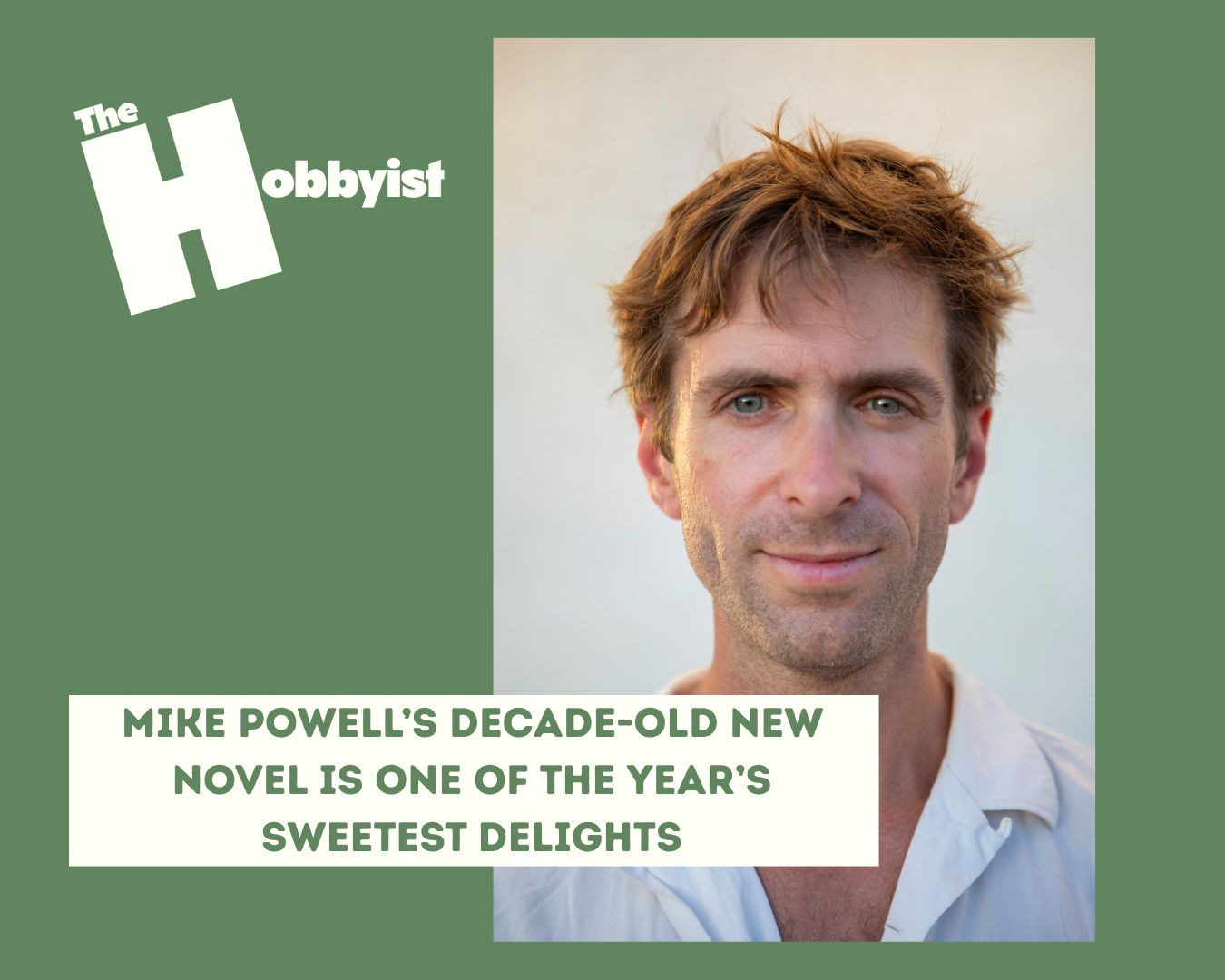
Photo by Andrew Emery Brown; graphic design by Thomas Euyang
If Substack existed in 2015, I would be interviewing Mike Powell about his brilliant work as a music critic. I’ve been a fan of the New York-born, Tucson-based writer since I was smart enough to appreciate insightful criticism — which is to say around when college began. Back in the 2010s, when my diet consisted of dining hall waffles and Pitchfork, Powell became a guiding light for me; both for who I wanted to be as a writer and as a listener of music. His Sunday Review (I think it was a Sunday Review?) of Silver Jews’ American Water remains one of my favorite things ever published on the site. All this would be more than enough for a sterling Hobbyist interview, I’m sure. But lo and behold, it is the year 2025 and the novel Powell has been working on for almost a decade-and-a-half, New Paltz, New Paltz, is out in the world. Even better, it fucking rocks.
The novel centers around Ben, a New York-based fact-checker at a gossip mag. The word “adrift” was created to describe people like Ben, who says things like, “Out of life, I wanted nothing more than the knowledge that I had lived it.” Powell’s writing is sharp and hysterical, imbuing Ben with a rare mix of brilliant insight and an ambivalence that’s almost infectious. “I agreed that life could be lonely but it always seemed too unusual to want to leave behind,” he says. You can practically hear the effort it takes for him to express such thoughts.
At 125 pages, New Paltz, New Paltz is the sort of book you think you’ll attack a few pages at a time before bed, but quickly devour into the wee hours. In my instance, it featured plenty of belly laughing at 2 AM, trying unsuccessfully to stifle my giggles in an attempt to make sure my wife wasn’t roused awake. This, as my interview with Powell makes clear, is all one can ask for in a book.
New Paltz, New Paltz is one of the most wonderful novels of the year, so good it led me to ask Powell questions like: “How did you make a book that’s so funny?,” and “What books should I read to be smart like you?” This, plus genuinely thoughtful responses to questions about balancing money with creative endeavors that won’t bring in big big money; reviving “old” work; and the pleasures of not living in New York or LA; make up much of this interview. We also discuss Square Books bumper stickers and writing fiction as a job. Check out our conversation below, and order New Paltz, New Paltz here. The chat has been edited for clarity and length.
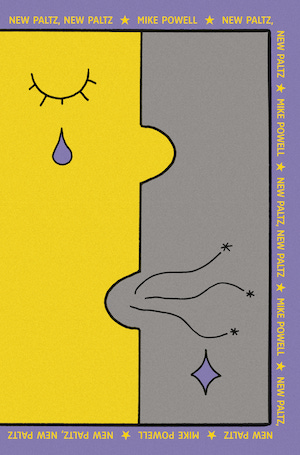
You originally wrote New Paltz, New Paltz in 2012. Was there ever a point where you thought the book wouldn’t exist as it does now?
Mike Powell: Yes. I didn’t do anything with the writing that I had produced. I wasn’t being aggressive—I don’t have a story about having overcome some great rejection. I had done some writing and didn’t really pass it along very much. I was in an MFA program and was producing writing. I wasn’t sending it out and getting it rejected—not that I would be embarrassed if that were the case. There was certainly a time when I stopped thinking about working on it at all. In some sense, maybe that’s nothing coming of it. There was definitely a time where the answer was ‘yes,’ I was writing and didn’t know if I was gonna finish anything.
It was finished though?
MP: This is both the line I’ve given and the truth, which is that there was a draft of it. It wasn’t very well tended. The oldest sentences that appear in this thing are from 2012. The draft that the people who run Double Negative Press read was 60% of the way there. There was significant overlap with what ended up in the book. When they said they were interested in publishing it, I, after many years of not spending a lot of time with it, thought, ‘Okay, well I really ought to give this a good look,’ if anybody else besides me and some very close friends are going to read it.
Obviously you are a very different person now from when you wrote the original manuscript. Was it a development of worldview that changed? Or were you just tidying it?
MP: Had I put my mind to it, been serious about it, and felt confident in it when I started drafting it years ago, I would have let it go. When I came back to it, it wasn’t, ‘Now I understand enough to finish the project.’ In a way, when going back into it, I kind of remembered what the project was about and the feeling of it. I was really serving the project. To the degree that I’ve changed in the intervening years, I don’t know how much that affected it. It would be impossible for me to know. If anything, it was easier to finish later because I had “working” brain. It didn’t feel as personal. I was doing a job, in a sense. So, it wasn’t a shift in worldview and the passage of time that didn’t allow me to finish it.
I hate to be so task-driven about it, but by the end of it did it feel like finishing any other freelance assignment?
MP: I’m certainly very task-oriented as a person. Knowing that people were interested in it was motivating. Making commitments to people about finishing the project allowed me, in a way, to finish it. Obviously, I care very deeply about it in a way I don’t necessarily engage with all my work because I’d be pretty tired. Doing a lot of writing for work means that there was a part of me that could sit back down and finish it and be serving the project as opposed to thinking about what I want or whether or not it was speaking to me at all times.
Between having a writing-intensive day job and having children to raise, how did you go about dedicating time to something that may not yield the same financial benefit as freelance work?
MP: My non-work writing and the time I allocate to it has changed since having children. When it came down to putting the hours into this project and finishing this out, it was a matter of just making sure I was up and working at 5:30 AM. It’s a familiar story for any working person or parent. If you’re gonna make that time, that’s when you’re gonna make it.
That’s where I’m at without even having children. If I wanna do any creative practice, it has to be early in the morning or late at night. After logging off at the end of the day, I need a few hours away from looking at a computer screen. If you’re doing copywriting throughout the entire day and then you have to take care of your children, there’s not a ton of time to dedicate to this task that may not yield riches beyond your wildest dreams.
MP: The riches beyond my wildest dreams…I’ve thought about this a lot. I do think that good creative practice yields riches beyond your wildest dreams. But balancing that with my material responsibilities is important. I think I’ve always been a very responsible person, so in a way it was harder for me to make the time to finish out the creative thing. I’m just not the type to run off and be like, ‘I need to tend to my calling or vocation.’ I’m very duty-bound. That’s okay, it’s just how I am. I was thinking about what I’ve read of The Hobbyist and having you in mind. It’s funny to realize that the thing I do for fun is just done in the same exact spot as the thing I do for money. That poses a problem sometimes. It’s not like I leave my computer and start gardening, though I do that too.
That’s the entire impetus for The Hobbyist. I’m trying to figure out how people do creative practices better than the way I do it. I’ve kind of fucked myself by making writing the thing I get paid to do because it’s also the thing I love to do with my free time. If I write copy all day long, it’s hard to write well for my own sake afterwards. My brain can’t turn that quickly. Maybe I’ll sell insurance or something.
MP: I don’t have a lot of clarity on that but I do think about it all the time. It’s challenging to shift gears. Some of my working voice makes its way into my fiction writing. Maybe that’s a good thing, maybe it’s not. I have so little time to consider it that I just don’t consider it too much, but when I sit back and reflect, I’m like, ‘I wonder what my writing life would be like if I were selling insurance or at X job.”
Or writing fiction full time.
MP: Sure. I don’t know. I don’t know what I think about that idea [laughs].
Now that you have a book in the world that people are enjoying, do you have motivation to pursue other fiction ideas?
MP: For sure. I’ve written a lot in the intervening years. It’s not like I have a full draft of a novel that’s ready to go right now, but I never stopped writing. It’s definitely motivating to see people enjoying it. I’m sure anyone who puts something creative in the world has that moment of satisfaction when people are enjoying it while also experiencing questions of whether or not to keep making time for the work, if it’s worth it; not the material sense, but for me it’s just time. Writing is a cheap hobby, all things considered. I’m writing, I love writing, and feeling like it’s resonating—just a person enjoying the work—is heartening. I had the experience of communion while writing this and other fiction that’s beyond all comparison. Once there’s a taste of that, I don’t care if anybody reads this thing. It’s nice if people do, but I know the feeling of the work is so gratifying at times that it’s worth pursuing.
That hasn’t changed now that you’ve had fiction published? You don’t crave that instead?
MP: In a way I think it’s just gotten worse [laughs]. I don’t want to be ungrateful, but now there’s a sense of what other people like. You have that voice in your head. I’m in the process of disentangling that. This is my first time publishing any fiction at all. I haven’t published short stories or anything and I haven’t been in a community with a lot of people that do. Having gotten an MFA is one thing, but sharing this work with people is a rather new thing for me. In a weird way, the public aspect has been sort of negative [laughs].
How long have you been in Tucson and what brought you out there?
MP: For 15 years. I moved in August of 2010 to go to the University of Arizona for my MFA. I stayed. This is sort of a digression, but I was an early adopter of remote work. I had moved from New York City and took my work with me. I did that through grad school and successfully after. I was working for New York and Los Angeles while living in Tucson. There are many, many things that I love about it, so I decided to root myself here.
Do you like being away from where a lot of the writing and culture work is? New York is fun but what I loved about being in Austin was how removed I could be from it.
MP: It’s a trade off. I was born in New York. I know it and I know that experience. I left because I didn’t like it enough. You make great sacrifices leaving New York or Los Angeles. I’m sure there’s more professional opportunity if you remain in places like that in terms of socializing or networking. On the balance, do I prefer being in a place like Tucson? Yes. Do I also harvest some schadenfreude from that? For sure. Every time I think about being involved in New York—going to events and stuff—it makes my skin crawl. I’m proud of myself for trying to carve out my space where I am and still make a connection or distribute creative work. It’s tougher being where I am than if I were in a place like New York. I want to succeed on those terms, obviously, because I’m stubborn and the rent is more favorable. I’m doing things I could not do materially in New York or Los Angeles.
You can do laundry in your own home.
MP: I can do it morning, noon, or night! I don’t want to be catty about it. I think it’s very impressive that people maintain busy, creative, generative lives in cities like that. It’s too much for me.
Is Tucson gonna remain permanent home?
MP: I don’t know, but I’ve lived here longer than anywhere else. In raising children in a place, you conceive of your commitment to it in a different way. I have to put my chips on it if I’m raising my kids there. I have to believe in it as a place and feel comfortable there.
Is there a literary community in Tucson that you’re a part of?
MP: There are writers and there’s a literary community. Because of its size and affordability there are plenty of people who are in similar positions to me; they go to graduate school there for whatever reason and they end up hanging out. It’s not big and it’s not something I participate in. I don’t want to look down on it, but I’m not a real joiner—for better and for worse. I met somebody recently who’s a bigger part of those things in town than I am. They were saying, ‘I can’t believe I haven’t met you before, I didn’t even know you existed.’ I was like, ‘I just don’t do these things.’ It’s for a zillion reasons, two of which are my children. I don’t have a lot of time to go out. But the town is beautiful and affordable and weird and there are people that take advantage of it being a viable city in which to make work and write.
What’s your reading practice like? Do you have time for it?
MP: I’m an every day reader, for sure. I was a reader long before I was a writer. It eats up what would be my TV time, and I love that stuff too. I read every night before bed. I’ve entered the “five things on my nightstand” phase, which is new for me. I was almost violently monogamous about finishing a book before I finish something else, but now I’ll just open three books on any given night.
I’ve been both, and I envy whichever one I’m currently not. I was reading an interview you did with Paul Thompson in which you discussed Charles Portis. He’s my favorite fiction writer. Who are some of your other favorites?
MP: He’s really a delight. I love Grace Paley. She was a great—primarily—short story writer but extremely funny to me. There are a couple of Clarice Lispector books that were really touching to me. I’m thinking of the early Sheila Heti stuff because I recommended her to my wife recently. I really like Yasunari Kawabata, a Japanese midcentury author. He’s quite famous in Japan and as an international author. I’ve read almost all of his novels at this point. I like Barry Hannah.
With Portis too, the Southern male not-too-harsh stuff really appealed to me when I got into literature as a semi-adult. Reading The Moviegoer by Walker Percy, that was a huge book for me.
I took a college course in Oxford, Mississippi and fell in love with that world, thanks in large part to Square Books there.
MP: I worked for the Oxford American for a little while when it was in Arkansas. The magazine had this connection to Square Books because it was started in Oxford. I regretted being in Oxford at least three times and never buying a Square Books bumper sticker that said “I’d rather be reading Airships.” Did you ever see that?
I never bought one but I do have a coffee mug. I’ll have to go back.
MP: I wonder if they still make it. I remember seeing it almost 20 years ago and being like, ‘For the 500 people in the world who see that and know exactly what you mean, it’s so good.’
Are you still a freelancer?
MP: I do write, but I work for the University of Arizona now. I was freelance for 20 years. Now, I have a regular job. I’m not doing a lot of freelance writing, but I’ll do copy stuff occasionally, though I’ve done very little of it over the past year in part because I wanted to take on a regular job and have it be fixed in place. I wanted to stop freelancing and make sure I could count on time for writing fiction.
I was finding that when I was working freelance and taking assignments, I was always taking on more work instead of doing more work for myself. I couldn’t resist a lot of times. I’m very fortunate materially, but I need to make money and pay bills. I can’t afford to not work. I was just piling on more work. My working life has changed in that respect. Before that, I’d always try to keep a mix of contract stuff and à la carte work. But I took a desk job for the first time and it’s actually quite nice in a lot of ways.
It’s also nice to know where your money is coming from every two weeks.
MP: There is that, but I had gotten into a pretty good rhythm and routine. The material stuff wasn’t as concerning. With freelancing, I had a lot of ego in it in some ways and wanted to perform well. I was too attached to it and it was draining. It’s not that I don’t care about the work I do now, but there’s a much healthier boundary. I now feel like I have the psychic fortitude to spend time and energy writing fiction. Before, especially when I was publishing more, I wanted what I wrote to perform and resonate. There’s nothing wrong with that, but I was very involved with it.
Now, when you do a Pitchfork Sunday Review or something, is it as much for your own pleasure as it is to write something that does well?
MP: I guess so. I wrote for them recently, and I realized that before that piece, I hadn’t written for them in five years. I don’t say this to lay claim, but I wonder how many people have written for Pitchfork over a longer period of time. It’s kind of gravy to take on a project like that. Now that I have a book out, I was wondering if I should pitch to more places like that to get my name out there. It feels like a hassle and boring, but it would also be a smart thing to do. I’m undecided and nobody’s exactly asking [laughs].
It would be smart to continue to produce freelance work, but I stopped producing so much because I cared less and less about it. I couldn’t get motivated to do it. That’s an unromantic answer, but at a certain point I had to accept that it wasn’t worth my time and I didn’t care about it as much.
That’s a good reason to find a new job [laughs].
MP: It’s nice to see how everyone else does it and it’s really awesome. It really makes a lot of sense to me [laughs].
Are you a passionate Wildcat?
MP: I’m not a sports fan and I don’t have school spirit, but I believe in public education. There’s something that feels good about participating in that system. It’s nice to be closer to that. It’s nice to be involved in something that’s local and has a big presence in the community. I feel rooted in a way that I didn’t when I was younger. Even when I lived in Tucson and was reporting to New York, I felt disembodied. I didn’t know where I was, exactly, though school spirit is a foreign ailment to me.
What’s one book you’ve read recently that you’d recommend to Hobbyist readers?
MP: My first thought is The Makioka Sisters by Jun’ichirō Tanizaki, which I recently finished. It was extraordinary to me. I don’t read a lot of big novels. My copy is 530 pages in quite small type. It’s about a prominent family in pre-and-during World War II that’s waning; there are four sisters growing into the modern era, dealing with their family influence fall away. In spite of myself, I was quite compelled by it. It’s a classic of international literature, so I’m not breaking new ground.
Another part of me wants to recommend The Ghost Soldiers, by James Tate, who’s a wonderful poet. I love every page of that book and have been chastised by my wife for laughing too loudly while reading it. Later in his life he was writing these prose poems, so they read like flash fiction in a way, but they’re astoundingly funny to me. If you like Portis…
That actually reminds me of something I wanted to ask earlier in our conversation. Your novel is really, really funny. Was that a goal of yours while writing? Did you want to make a book that was funny? Or was that how your style just emerged? Do you view it as funny? There are a lot of questions for you.
MP: Yes, I wanted it to be funny [laughs]. You’re at the risk of sounding ridiculous if you say, ‘I thought it was funny and I wanted it to be funny.’ Do I think it’s funny? I enjoyed writing it and I wanted it to be funny. I think humor is deeply valuable. It’s tough to do, so I congratulate myself if anyone finds it funny. I love laughing and I love laughing while reading. I’m philosophically on team humor.
Good job then. Congratulations.
MP: Thank you. I really do take that as a compliment.
Fantastic interview, especially because it reminded me that Mike has a novel out (there was some chat about that in my group, uh, chat), which I have now ordered and am very much looking forward to reading. Not at all surprised to hear that it is funny because Mike is one of the funniest writers I know, but without even trying—it's just naturally woven deeply into his writing.
This is a great interview and I am glad to see Mike’s book getting some more attention. I also read and posted about it, and enjoyed the humor very much. And not just saying that because Annie (the wife, not the cat from the novel) is a friend!