

Ed Park Hates the Word “Content,” + More Reasons Why He’s the Best
With his new book of short stories, “An Oral History of Atlantis,” out now, I spoke with the New Yorker about the Buffalo Bills, becoming a Dead Head, and advice for aspiring novelists.

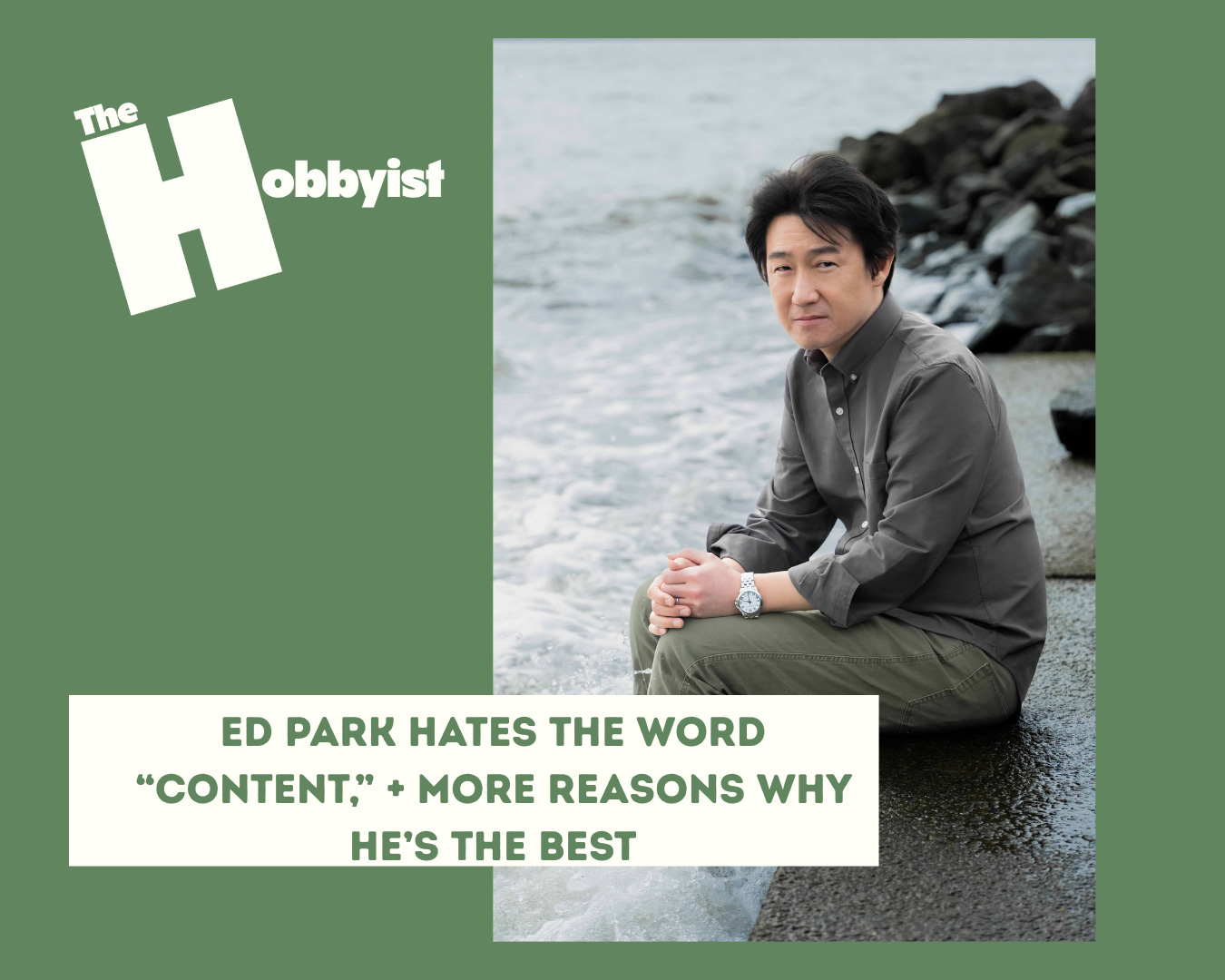
Photo by Beowulf Sheehan; graphic design by Thomas Euyang
I became a fan of Ed Park’s work relatively recently. Back when his first novel, Personal Days, was released in 2008, I was 15 and didn’t really know how to read anything that wasn’t a Ken Griffey Jr. baseball card or a stat line in NBA 2K8.
By the time his second novel, the brilliant Pulitzer Prize finalist, Same Bed Different Dreams, arrived in 2023, I was a fully engaged reader and even tapped in enough within the literary zeitgeist to know that Park’s latest was a Big Deal. It lived up to all hype and then some, becoming one of the most memorable reading experiences I’ve had in the 2020s. More recently, I’ve gone back to Personal Days, which is an absolute joy; simultaneously riotously funny and miserable and inventive and tense and breezy.
Now, here’s lil’ ol’ me with a Substack, and none other than Mr. Park himself clicks the “subscribe” button. I was tickled. Surely it was an accident, but I was ready to take advantage of my fortuitous situation irrespective of circumstance. Around the time we became mutuals on the app, he released his latest book, An Oral History of Atlantis: Stories (also a Pulitzer Prize finalist. The collection of short tales includes writing from the mid-1990s until present day and is as engaging as his longer, knottier novelistic endeavors.
“Mr. Park, come be a Hobbyist!,” I requested. He, much to my surprise, eagerly accepted my invitation. Not only is Ed Park one of the finest writers currently living in our country or any other, but he’s also a very nice person. Ed’s generosity with his time and ideas is one of those things a small but mighty Substacker like myself needs every once in a while to become a power player in this ecosystem of pennies and Restacks (I can, of course, separate Ed’s spirit generally from its existence in relation to my interview requests).
All this to say: I would speak with Park all day long without a tape recorder anywhere in sight. He’s thoughtful, extremely funny, curious, and electrifyingly passionate about books. The conversation we had is one that makes me excited about reading, but also writing. That’s right folks…My novel is officially back on. Just kidding. Maybe? Hedging all bets today and forever! Happy Sunday. Read our conversation below, which has been edited for length and clarity.
Are you still teaching at Princeton?
Ed Park: Yeah, I teach a speculative fiction workshop. This is my second year, I believe. I began in the fall of 2023. It’s been a lot of fun. I’ve taught before, just regular fiction and some non-fiction type of classes. This one is specifically speculative fiction. Anything unreal—science fiction, supernatural horror, surrealism—falls into that category.
Have you kept the reading list the same each year?
EP: I’ve actually updated it. I work mainly out of this anthology that I came across while I was doing my science fiction column for the LA Times. I did it for about four years. It was quite a while. It was every month and I was cranking through it. Towards the end of my time there, around 2010, I found this anthology called the Wesleyan Anthology of Science Fiction that I thought was very good. It began at the turn of the century. There was an E.M. Forster story and it went into the golden age writers; names you’d recognize like Arthur C. Clarke, Heinlein, and Asimov. There were also some more obscure writers from around that era.
It kept going up until what was then the present, with Ted Chiang’s story, “Exhalation,” which is amazing. Now I’ve read these stories so many times, but there’s so much pleasure each time you read something like “Exhalation.” The metaphors that he can create are just incredible. I tinker with those stories, but then I’ve added some more current stories that I’ve come across in my own pleasure reading. It’s fun. I’ve got a good framework from which I can subtract and add. Since it’s a workshop we do a lot of student work for about half the semester.
You study the greats then try to write your own addition to the canon.
EP: Exactly. These students are much younger, 18-22. The things that they’ve read don’t necessarily track with my history of science fiction. I learn about some things from them, but I think they get a kick out of most of the things I introduce them to.
Your career as a novelist is so interesting because it spans such different parts of the publishing landscape. Your books came out in 2008 and 2023. Was that gap between novels a choice? Publishing issues? Writer’s block?
EP: It’s probably a little bit of everything. I wrote Personal Days fairly quickly. It was my first published novel. Before that, I had quite a few unpublished books; at least two unpublished novels and a couple long things I could never finish. I also had this unusual memoir which I wrote in ‘98. I lost it, and recently found it again. It’s actually going to be published next year. When Personal Days came out, it was really exciting. I was 37 when it came out. I’ve always been writing fiction but it opened up some opportunities.
At the same time, I had other responsibilities. I had gone from being an editor at The Village Voice to a freelance period. Then I started teaching fiction. Most importantly, I became a father. My eldest son was born just a few months before Personal Days came out. I was in the mix of that, I became a book editor, and I was still writing freelance pieces. It was a lot. I’d never been a book editor before, which was really interesting, though ultimately really helpful with my own writing. Finding the right idea that could hold my interest and be something unique took some time. I found it and started writing it in 2014. A year, two years passed, and it was going in the wrong direction. I used some of my book editing skills to shake up my own manuscript. It was a nine year process. You don’t start writing a book thinking it’ll take that long, but at the end of the day it had to take that long to become the book I wanted it to be.
It reminds me of a basketball star who makes the NBA Finals at a very young age. Everyone think he’ll be back there every year, but it’s really hard. Your first book obviously took a lot of work and time, but it seemed like it was a fairly frictionless process, at least compared to Same Bed Different Dreams.
EP: Totally correct. I don’t want to be judgmental, but when my first book came out at 37, I was like, ‘It’s about time.’ I had friends and peers who published their first book much earlier. There was a feeling of, ‘Am I ever gonna publish a novel?’ It was a great relief, but the next one didn’t come just like that. If I can backtrack a little, I was working at The Village Voice for a number of years when I started writing Personal Days. When I was suddenly laid off, there was that urgency. Psychologically, it must have helped in some way. I gave myself some time to finish the novel and I made a concerted effort to make it something publishers would want to publish and readers would want to read. It was all brought on by my career and financial situation. Things got a little tricky with a different job, family stuff, and trying to balance it all. It was a lot.
Do you have a daily writing routine you’re dedicated to?
EP: I do. If you asked me a year ago, it would be: I get up, I put on a record—usually a classical LP without words. I would put it on, and use a typewriter. It was just a good way to not be online and to let the record dictate each bout of writing. If I can make it through a 30 minute side, that’s pretty good. If I’m still feeling inspired, I’ll hit play again or flip the side. I did that religiously for a while. I almost did that today, but I’m still grasping at what the novel project I’m working on should be. There are questions, and I feel like I need to work in a word document. I’m trying to move a little quicker, but I’m also doing a lot of crossword puzzles. Just thinking of The Hobbyist, that’s become my hobby. I do a lot of them at all hours of the day [laughs]. There’s usually a small one to start the day, then I’m doing The Times’ and a bunch of others. I go through quite a few every day. I like to think it’s helping my writing, but I’m not sure it’s true.
Now I’m less rigid about having to listen to a baroque record, for example. I’ve never said this publicly, but for the last month or so, I’ve become a Deadhead. I was aware of them, but I never really got into them at all. Now, it’s all I can listen to [laughs]. In a way, it’s okay because it’s just the same songs in different permutations from different live shows. I can let it wash over me and activate certain parts of my brain, but it’s definitely different from my previous routine. Having said that, I am feeling the itch to work some stuff on the typewriter, so I’ll probably go back to that.
Do you mostly work from home?
EP: Yeah. Back when I was a book editor I’d rent out a space away from home, but during the pandemic I couldn’t go there and just stopped. It’s good to be at home because I can get out of bed and walk to another room. I have a desk in the kitchen area, which is generally where I am. My older son just went off to college so sometimes I’ll use his room. There’s a certain time of day where the light is really good in his room, so I’ll try to go there in the mid-afternoon.
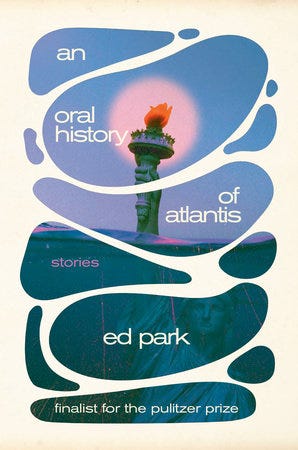
Photo via Penguin Random House
Are you still involved with Little A? I know it started as your imprint.
EP: I’m not. I hadn’t been involved in publishing before I started working there, and I went to Penguin Press in 2014. When I left, I didn’t have any association with it. There’s a writer I published there named Shawn Vestal, who I then got to publish at Penguin Press. I’m still connected with some of the writers from both places, people I think the world of, though I’m no longer in the publishing world as a book editor any more. It was a really good experience, though it was really tough. It teaches you just how many people it takes to make a book. It’s not just a writer coming up with an idea and pounding it out. There are so many people involved. It’s really interesting and helpful as I was finishing Same Bed Different Dream. I needed to think of how the entire editorial machinery was going to work.
You’ve been on the publishing side and also earned a Pulitzer Prize nomination for your last novel. You’ve been successful on both sides. Are you optimistic about “author” being a viable career path in this era?
EP: I always have to be optimistic. It’s funny you should ask that because I recently had breakfast with a long lost friend of mine. My father was a psychiatrist from Korea, as was his dad. We grew up in Buffalo together but hadn’t seen each other in 25 years. He was telling me his eldest son had just graduated from college and wants to be a writer. I don’t want to speak for my friend, but as a parent you can understand questions of security and whether or not it’s a wise idea.
There’s a lot of stuff to be worried about on many levels in the creative fields. When I was younger, I started out as a copy editor at The Village Voice and learned the ropes of what that kind of editing was like. I became an editor there and started writing a lot for them. I don’t know that copy editing is actually even a thing at most places any more. Even The New York Times stopped a while ago. Technology moves at its own pace. I don’t know if entry-level jobs that could help you get a foot in the door still exist. On the other hand, there’s a lot of writing online and there’s a lot of community to be had. Even though I’m a bit of an old fogey, I think there’s a human need to express oneself, and I don’t think that’s ever going to go away. You can talk about AI, but that core feeling will still be there. Writers will find a way to write and I hope publishing figures some things out and will serve both authors and readers in a positive way. I hope that’s not too rosy a position, but I’m feeling bullish.
I’m a freelancer and any time I turn in a piece and the editor comes back with actual edits, I’m pleased. That relationship doesn’t really exist any more because every one is overworked, underpaid, and chiefly concerned with producing “content.”
EP: This is my old fogey-ism again, but why is it “content?” I’m used to that word now too, but it sounds so anonymous and fungible. Even describing someone as a “creative” is weirdly diminishing. They feel like terms used to put artists in their place, but I don’t think art can ever die.
You released a book of short stories in July! What’s the time period in which those were written?
EP: It’s a pretty big stretch. There are 16 stories and it covers my entire career, since I first started publishing. The first story I wrote in ‘97. I was sitting in the copy department at The Voice and there was a full page ad for an anthology called Virgin Fiction. It was for first time authors. It was an imprint of some major publishers. If a story was accepted, you’d get $500 and the story would be printed. I had come to the end of at least one of my long, unpublished novels and was feeling exhausted. I had this idea of a Nabokovian figure who’s very particular about his words, and his novel is being translated very poorly into English. It was called “A Note To My Translator.”
There are some stories in the book that were almost like Mad Libs. The jokes were there based on the title and concept. There are several stories like that, almost more like lists than stories. With many of the stories, I was trying to be funny, overtly humorous, but at a certain point towards the end, the pathos comes in. A lot of the stories are like that. Many of them were written for readings for various publications and events. Working full-time, that was the only way to give myself a deadline. Most of the stories are from the 2010s, but each decade is represented, and the most recent one came out last year. It’s called “Machine City” and it’s one of the longer ones.
One of my favorites.
EP: What’s interesting is that with some of the stories I can figure out a new development in my style. You can’t be too conscious of that while writing, but afterwards you can sense that something changed. That’s always gratifying.
It’s cool to track your development in a very tangible way. What’s it like going back and revisiting these stories that are older? Sometimes when I look back at work I did two years ago, I cringe. Maybe it’s different with fiction, or maybe it’s just a sign that I’m still not a very good writer [laughs].
EP: I was recently thinking about a nonfiction piece I wrote, and as a thought exercise I imagined someone requesting to see a collection of my favorite nonfiction pieces. I was at my computer and would remember something I wrote in 2006, or something. You’ll perhaps feel the same way, but as time goes by, some of the stuff is even better than I thought it was. Not to sound immodest, but I was like, ‘How did I do that?’ I was writing so much. You were talking earlier about “content,” and I’m not saying that every single science fiction column I wrote was this work of art, but some of them are written in a style that I no longer have. The amount of verbal firepower and allusions, I’m like, ‘How did I do that?’ It turned out to be a fun walk down memory lane.
You just need to re-create some of those desperate circumstances.
EP: It always feels a little bit desperate [laughs].
Do you still find much time to read?
EP: This morning I woke up really early and my first thought was, ‘I’m just gonna read a novel.’ I remember someone saying that The Anatomy Of Melancholy was the only book that made them wake up an hour earlier so they could read. I started thinking about that and just started Bleak House. I just read a chapter recently and it was so good. I haven’t read much Dickens, but I decided to do crossword puzzles instead [laughs]. In theory, I always have a bunch of different books going on. My tastes shift a lot. Five years ago, I could only read thrillers by Harlan Coben. I went through them like water. As my book of stories came out, I was reading a lot of short stories. Now, there’s Bleak House and Stephen King’s Salem’s Lot. My memory of it as a kid was that I stayed up until 2 AM or whatever finishing it. I’m reading it again, and I don’t really remember any of it, but the writing is really good.
I read Bleak House in college and it’s one I’m so glad I was required to read because Dickens takes discipline I don’t always have.
EP: After we talk I’m gonna try to chip away at it a little more.
Do you have any hobbies that aren’t related to words?
EP: I’m not Mr. Athlete but I grew up playing a lot of sports. I like skiing when I can ski. I’ve been playing quite a bit of tennis this year. I played a lot as a kid, and now I live somewhat close to some courts. My wife and my kids all got into it, too. I like a little bit of physical activity and I like watching sports.
Are you a Bills fan?
EP: Very much so. Did you watch last night [November 2]?
I did. I’m very happy for you guys.
EP: I was so nervous. I went for a run at the beginning and was just listening to it. I get so anxious about these games. At the end I got a little anxious, too.
I get more pain than pleasure watching. Especially the Knicks and Mets. I have to follow along with one eye closed.
EP: I was never a huge basketball fan but my kids both like it. We went to a Knicks game, and I was gonna say it was my first pro basketball game, but when I was a kid, Buffalo actually had a team called the Buffalo Braves.
They’re now the Clippers!
EP: Yes! I should become a Clippers fan. My dad took me one time, but they were gone the next year. I loved watching the Knicks. You’re close to the action. So yeah, I watch sports and I do a little bit of physical activity. I used to be much more into playing the guitar, but I just listen to The Dead now [laughs].
What’s one piece of advice you’d offer to someone writing a novel?
EP: Get off your phone and don’t write on a computer if you can help it. If you can find a manual typewriter that works, I think it’s a good investment. It sounds mystical, but you’re closer to the words and language. I’m not anti-technology, but for a sustained thing like a novel, you really do have to live inside it. In that regard, you have to do it every day. For me, I’m a morning person. It doesn’t matter when it is, but try to get something done. Even if you’re just staring at it or writing stuff that’s not good, I do think you’re arriving somewhere.
I’ll also say, I’ve found plenty of stuff I’ve written and abandoned, only to come back to it later and think it’s pretty good. I’ll finish it, or insert it into something. Keep all your stuff. Have it somewhere.
What’s one book you’ve read recently that you’ve really loved?
EP: I should have seen this one coming.
It’s kind of a lazy one, but it’s also for my personal interests, too.
EP: Have you heard of this book called Service by John Tottenham? I was kind of into it. It’s from the point of view of this grumpy bookstore clerk, who’s a failed/aspiring writer. His life and career have passed him by, but in complaining about it, he starts writing a book. It sounds kind of meta, but it’s really funny. Some people think it’s maybe too long and one joke over and over again, but I don’t know. I saw it in a bookstore and his last name is Tottenham. I’m kind of a Tottenham Spurs fan.
I didn’t know anything about the author, but I think he’s British. I don’t know if you’ve ever thought this, but sometimes the best way to experience a book or movie is to not know anything about it. Something about his name, the title, and the cover was intriguing. I checked it out and it was really good. He’s known for his poetry, but I had no idea who he was. That’s the most recent novel I’ve read that I really liked.
Dr. Johnson said that abt Burton !
great intv. i just recently re-read 'Salem’s Lot and it absolutely rules. When I find I can't read at all, I can always rip through a Stephen King book. The longer the better.