

You Can Find Björn Yttling on the Rink (or on the Court, or in the Studio, or at the Jazz Club)
We caught up with the Swedish rock icon to discuss Peter, Björn, and John, taking a few points off John McEnroe, and the robust Swedish-NHL pipeline.

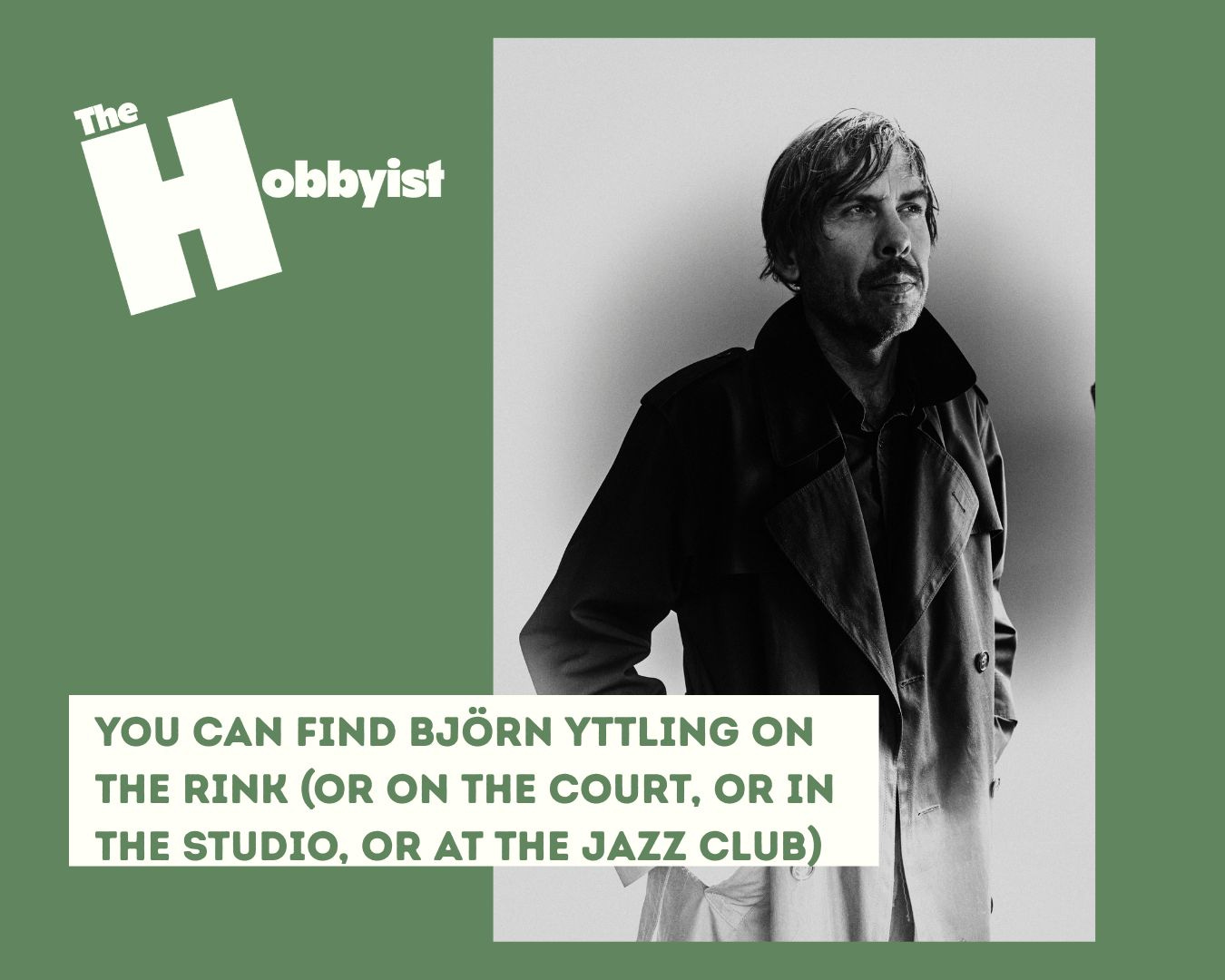
Photo by Fredrik Bengtsson; graphic design by Thomas Euyang
You know Björn Yttling because of a whistle. Yes, it’s that Björn. The Björn of Peter, Björn, and John, who in 2006 unexpectedly took over the world with the undeniably infectious whistle-led single “Young Folks,” an indie pop anthem for disaffected youth that skyrocketed the Stockholm-based group from mid-level songwriters to globe-trotting superstars. A footnote of the era, though, is that a year prior, Yttling had released his first jazz album, Oh Lord Why Can’t I Keep My Big Mouth Shut. If upon the release of the second Yttling Jazz album, Illegal Hit, you found yourself wondering why someone would take 20 years between jazz albums, the answer is clear. He got pretty busy.
In the interim — the post-“Young Folks” era (you’ll remember even Kanye West turned “Young Folks” into a beat for a song) — Yttling’s production career skyrocketed as well, as he helmed records for Chrissie Hynde, Lykke Li, Franz Ferdinand, and more. Yttling was simply too booked up to cook up some heady jazz compositions, which is a shame, because as he makes clear on his 2025 Year0001 release, he makes absolutely stunning work.
In our interview, he spoke about extrapolating ideas from eras as disparate as the post-hard bop style of 1959 and the modern avant-garde alike, and Illegal Hit is inspired by both of those things but also deeply interested in the 2010s transmogrification of the genre. Take “Malgomaj” which sounds a bit like an Ennio Morricone score, and a lil’ like a Moondog skonk.
The album is one thing, but I was particularly enthused to hop on Zoom with Björn because I heard whispers of substantial prowess on the tennis court. All rumors are true. From his days of living in the East Village in NYC, to LA work trips, Yttling always has that thang on him (a tennis racket). He even claimed to have taken a few points off of John McEnroe back in the day. Fact-checkers were unavailable to substantiate the claim, but I’m validating it as true. While Yttling was once smacking Wilson 12 or 13 hours a week, that time has been cut in half of late as he has rekindled a romance with another favorite hobby: ice hockey. Racquet sports, ice sports, and excellent jazz music? Björn Yttling is my kind of dude. Check out our conversation, edited for length and clarity, below. Purchase the latest Yttling Jazz album, Illegal Hit, here.
Where’s home for you?
Björn Yttling: Stockholm.
Are you in your home studio right now?
BY: It’s an office. Me and Pontus Winnberg have a studio called Ingrid Studio. There’s a bass organ here that we had in the main room but it’s not a studio. We wanted to switch things up a little bit which is why it’s here. This is a nice office because you can sit and write.
I know you’ve spent some time in New York. How often are you back in the States?
BY: Maybe four times a year.
Is that mostly for work?
BY: Mostly, but I was there in June for a vacation in New York. The family was with me, which was nice. I usually go to LA, but I like New York better. I played records at The Lot, which was great. It was mainly a vacation, though.
You have done a ton of producing. Is that as active as it was in the late 2010s?
BY: Not really. I’m making a new album with Lykke Li. I do that, I do Peter, Bjorn, and John, but I mostly do my own stuff; not as much for other people right now.
Illegal Hit is fantastic. How did the idea to revive the jazz project 20 years later happen? When did the process begin for you?
BY: We had a session here at Ingrid Studio with Joakim Åhlund of The Teddybears and Jockum Nordström a couple of years ago. He’s, I guess, the biggest painter in Sweden. They have a great 70s-sounding jazz group. I played some piano for them here. Jockum was like, ‘If I could play like that I would play all the time’ [laughs]. That planted a little thought. Then I started working on the jazz album.
How much of it was written when you brought the band into the studio?
BY: I wouldn’t go in and jam. I can do that, too, but I wouldn’t book two days and jam. I’m not making Bitches Brew here. I’m more into the song side of it. I went in with a couple of guys to just try stuff out, sort of pre-production. I did that and recorded it with a couple mics. Some of that is on the album, too. “Schoolbus On A Weekend” is a first try session rehearsal I did. Some songs I re-recorded with more people, but I didn’t do a long session where all the songs were already planned and mapped out. I recorded a few songs and then wrote more. Then, I would change sections or add parts to some I recorded. When you go into the studio, anything can happen, even more so with music that incorporates improvisation.
How big was the band you recorded with?
BY: It depended on who was available, but I always had Dan Berglund [bass] and Fredrik Rundqvist [drums]. If I had them, then I looked into who was available. I usually had the vibraphones, because I love the vibraphone and Mattias Ståhl also plays the harmonica. I would also have horns, too, depending on the song. Sometimes it’d only be the trio and one rotating member, too.
I love the vibraphone.
BY: It’s so good. I love Mattias’ style. I really think he’s one of the best. I did some recordings in LA and I tried to find a vibraphone player but couldn’t find anyone as good [laughs]. There are some guys in New York, but I’m happy to have Mattias. He’s very technical and has a beautiful tone.
Are you writing parts for someone like Mattias? Or does he improvise off of the main structure of these songs?
BY: I generally wanna hear the vibraphone play the melody. If it doesn’t work, we do something else. They’re very trusting of me, I guess they have to be, but they can play whatever they want. If you can’t do that you have the wrong people in the room. It’s my screwup for bringing in the wrong people if I don’t allow them to contribute. Sometimes a song won’t work, and that’s okay.
Was there any subgenre of jazz you were particularly inspired by?
BY: It’s kind of basic bitch jazz knowledge that ’59 is a great year, but for me it’s really good because it’s getting into the free jazz vibe but still keeping a lot of hard bop and arranged stuff. Mingus and Ornette Coleman from around that year is just golden. Any decade that mixes the written arrangements with the improvised freedom is great. But I’ve also been looking at Benny Goodman and Paul Whiteman, too, to find inspiration. I looked to them, and Duke Ellington. Plus later stuff that’s also sublime, like Cosmic Ear, who released an album this year. That has Goran Kajfeš on trumpet and Mats Gustafsson on saxophone. He’s a big free jazz saxophone guy. Maybe it’s not arranged but there’s a vibe that’s arranged, as opposed to harmonies.
You released the first record and then Peter, Bjorn, and John exploded. Was it hard to pursue the jazz project when “Young Folks” was taking over the world?
BY: It was hard. I thought I was gonna make a jazz album every year. That’s not realistic, but neither is one every 20 years. We recorded the first Yttling Jazz album in 2005 and we also started recording Writer’s Block. I also recorded the first Smile/Abstract Crimewave album that year. I’m not sure we recorded anything, but I also met Lykke Li that year. It was a good year and I recorded some other stuff, too. I was in the studio doing so much stuff. The first Yttling Jazz record was recorded in a day over the span of eight hours because I didn’t really have any money. We made it happen between 10 and 6. This time, I had the opportunity to go in and out of my own studio. Peter, Bjorn, and John happened in 2006 and it was 180 shows to do and not much else to think about.
Has the new record lit a fire in you to put out more jazz albums?
BY: It’s been so much fun recording stuff. I could even just record it and not put it out, just for my own sake. Playing with these guys is fantastic. But it’s also fun to edit and make the songs ready. I was out in the Stockholm archipelago working a lot on the edits. I’m looking forward to doing that again. Playing the songs live has been a blast. We have different lineups almost every show, but we’ve been doing arrangements for different sized groups. It doesn’t really matter, we find our way. We played some shows in Sweden and Mexico. I’m gonna keep going, I’m pretty sure.
Do you want to tour this album around the world?
BY: I talked to my booking agent in the States and he was like, ‘Naw’ [laughs]. If I do that maybe I’d bring in American musicians because it’s tough with visas and it’ll be very expensive with flights. I’m gonna look into New York and do a session and see what people I can find. We’re going down to the Netherlands in January, too. Europe is easier, of course. It would be fun to go to New York because it’s the home of jazz.
Selfishly, I would love to see some shows announced for New York.
BY: Me too. When I was living there, John Zorn had a club.
The Stone. John Zorn is a legend.
BY: Yeah, I listen to him a lot, especially when I started getting into jazz. There are so many spots in New York to play.
What’s the Stockholm jazz scene like?
BY: I’ve known all these people for 20+ years, because I went to school with some of them. I haven’t paid as much attention to the scene but I encountered a lot of great free jazz. Like anywhere else, there are some lame singers [laughs]. I haven’t been a regular at shows but I’m trying to get more into it now. I was into the avant-garde stuff back in the day, too. In the ‘90s I saw everything because I had a teacher that had a jazz club, actually called Village [laughs]. He let us in for free when we were 16 or 17. I saw everything, but after that it was hit or miss. Now, though, it’s growing. There are a lot of great players, but every time we try to get them they’re in Japan or Germany making records or on tour. My friend Magnus Lindgren works a lot in Germany on the ACT label. I don’t see him much. I see him more on the tennis courts than in the studio, but I’ve known him for 35 years.
Were you familiar with YEAR0001 before they released the album?
BY: I’ve known Oskar Ekman, who runs the label, since he worked at the booking agency I’ve been with since the mid-’90s. They’re just across the street from Ingrid, too. I’ve wanted to work with them and we’re doing that with the Ingrid sublabel. He’s a great guy. Of course I love Viagra Boys and Yung Lean and all the stuff he’s been putting out. They’re literally 50 meters from our studio. We see them all the time. It’s a big community here, actually, and they’re a part of that.
I know that you recruited friends like Matt Sweeney and The Tallest Man On Earth to remix some songs for the record, and you remixed a Bonny Light Horseman song, too. How does remixing make its way into your musical style?
BY: Since we’re working with Year0001 and we did the campaign in a pop way. When you put out a pop record you always put out remixes and different versions. I thought it’d be easy to put some words on these songs because it’s instrumental [music]. I asked the Tallest Man On Earth to put something over a song, and it’s just like him putting guitar and vocals over it, which was so cool. Joshua Idehen put out a remix, and he has a Swedish producer so he’s been here a lot. I didn’t know him that well, but my manager introduced us and I’m really pleased with that remix. Not all of them came out, but it’s just fun getting different takes on these songs. It worked commercially, too, as much as it can work; but it’s mainly for my own sake [laughs].
How do you and Matt Sweeney know each other?
BY: When I lived in New York he was on a couple records I recorded. It was around 2007, I guess. He was around the East Village and I needed someone to play. I also used Steve Shelley a lot. He’s a great rock drummer but a big jazz head, too. We went out to where Sonic Youth had their studio in Hoboken and recorded a lot there. I was there with Lykke mixing her first album. Matt has great energy and knows a lot of people. He was always like, ‘Let’s go to the Alan Lomax archive’ or ‘Let’s call Neil Diamond’ [laughs]. There’s always stuff happening. I like him a lot and I like his playing a lot.
When did you get into tennis?
BY: When we started touring more. Before that I played badminton [laughs]. I’ve been playing a lot, maybe too much. You play two hours and you wanna play a third and that’s not a good idea. At my peak I played 12 or 13 hours a week. It’s been so fun. I played every morning when I lived in the East Village. I played in Bangkok, Jamaica, Australia, it’s the same everywhere. Plus, you get a decent workout. John and I from the band played a lot, plus we had different people in the entourage who played. I met McEnroe through Chrissie Hynde and I played him. I took two points from him and he was so unhappy with those two points. It made my day. Here in Stockholm I play at the same club that Björn Borg played. He’s stopped playing now. It’s not a super big sport in Sweden, but it’s decent and people are into it.
How often are you playing now?
BY: I play two or three times a week because I’ve been playing a lot of ice hockey. I play in LA when I’m there, three or four times a week. When I’m there it’s so hot you can’t really play tennis. The ice hockey and the tennis is a good combo.
What position are you?
BY: Left wing.
I’m a big Rangers fan. Do you follow the NHL?
BY: I did because there was a player from up north in Sweden who was one of the first from up north who came to the NHL. When he lived in New York I saw them a lot. It was around 2010 and they were really good. I went to a lot of games. I’ve also gotten to know Ulf Nilsson, who has been to a few shows. He also knows McEnroe. He’s a good dude. He was such a big deal in Rangers history.
One of my favorite golfers is Swedish. Ludvig Aberg.
BY: You’re usually from way south if you play golf because otherwise there’s snow half the year [laughs].
Do you mostly play tennis indoors during the winter?
BY: It’s mostly indoors because we have such shitty weather. We have a short period, maybe four or five months, of outdoor tennis. But then you curse the wind and you go indoors again.
Who’s your NHL team right now?
BY: The Rangers are big for me but I like Nylander in Toronto. I actually saw game 7 in Toronto versus the Panthers. If you have a soft spot for Toronto it was a bad game. I was lucky to catch it. I also like Detroit because there’s a new defenseman from up north named Axel Sandin-Pellikka. He has really good hands on the blue line and he’s from the team I root for here in Sweden. He’s fantastic. Fearless and wonderful.
He’s a baby, too. I think he’s 20.
BY: He’s so young and not big at all, but he can really read the game in a beautiful way. The Red Wings also have Jonatan Berggren who’s also young. He’s a power-ish forward. Viktor Arvidsson, who plays for Boston, is from my hometown too. He was a late bloomer because he’s so short. I don’t think the NHL wanted him at first [laughs] but he’s definitely a favorite of mine too.